It would appear from all documented sources that the name Thomas always retained for the first-born son of the head of the family. Thomas O’Ciardha of Offaly, Fore, was believed a branch of the Cahill family, of Connaught; derived from Cathal, number 102 of the Cahill of Connaught pedigree. He was also known as Thomas Baintreadhachd (Thomas the Widower) being the ancestor of Keary of Fore, from Co. Meath.
In Hart’s Irish Pedigrees of 1887, pp499, Keary or Carey of Fore, Co Westmeath, were descended from Dermot O’Ciardha of Offaly. During the 1650s, he reverted to the Keary form of spelling, because another member of the family, using the C, had become a Protestant. Today’s Herald questions Hart’s interpretation.
Thomas O’Ciardha was killed by Cromwell’s Parliamentarian troops, in 1654, at the burning of Saint Fechin’s Abbey. The monastery was an important monastic centre founded in AD630 later to become a small-fortified town defended by two gates, a canal, a mound and a ditch. The monastery withstood several burnings and raids eventually becoming an Anglo-Norman Priory under the rule of the order of St Augustine. The last Prior, William Nugent, surrendered the house and possessions to Henry VIII. The town of Fore allied to the English – being close to the English ‘Pale’.
It was during the sacking of the Abbey that Thomas’s’ three sons: Thomas the Elder, who married Mary O’Brian of Naas, niece of Hugh O’Byrne, Patrick, and James, escaped – found refuge with Hugh O’Byrne of Dublin, one of the Confederate Catholics. In the early 1600s, the O’Byrne family, owned vast estates round Clare, Naas in Kildare, and Wicklow. Thomas died in Spain, nine years later. Patrick entered Spanish service in the military, and Hugh married Margaret O’Brian, daughter of Dermot O’Brian of Naas. Their son John O’Brian married Mary, daughter of Owen M’Kewen of Clontarf and Swords. Their second child was a daughter born in 1749, who married in 1780, Hugh O’Moore of Longford, Castlepollard, in the County of Westmeath. The whole family were Catholics – held Gaelic allegiances to language and habit.
In 1653-65 Leinster was one of four equal land provinces of Ireland made-up by areas such as Kilkenny, assigned by the English parliament as security for soldiers and adventurers, Carlow and Kildare, kept as a government reservation, and Queens County kept aside as an area included in the plantations of the Catholic James I. The throne of England was, after James II, occupied by Mary and William of Orange – hence Irish Protestants becoming ‘Orangemen’. This reign effectively destroyed the Catholic landowning classes. The outcome of the Cromwellian plantation period found some Irish catholic citizens selling-up, others quite demented by worry, some running away, and others executed. The transportations completed finally in July 1655. There were many arrests for failing to transplant; in fact so many that the goals were full… hangings made space available, until an excuse was made to let some go. Those picked on and freed were landowners not the landless. A few years later some of the new owners sold up, to others who increased their grants by purchase to become the new ‘gentlemen landowners’. It was generally a clearance of the old landowners and even in the Restoration; things were never the same again – the old ways in Kilkeary disregarded. Some old freeholders went to Irish counties whilst others went aboard, mainly to Spain and Holland – away from English influence… changing their names and making a fresh start. By this time, the clan was almost non-existent.
In the Civil Survey of 1654-1656, the Parish of Kilkeary, spelt Kylkeary, showed even at that late stage spellings were still not regularised, it also suggests that the parish was considerably larger containing several townships and parcels of land. The parish began at the ford of Bellasuillsane, at the river of Geagh, bounded with the parish of Kylnaneafe followed the river southward to Poellacholla, which adjoins Tampledony, Ballymacky, Grenanstowne and Lisbony. The parish described in the survey as having good arable meadows and pastures, several springs and a number of plough-lands. The Hearth Money Rolls indicate that several members of the family living in Co. Tipperary started to use the English form of Ceary to retain their estates. They were better off under the Restoration settlement, for they received back three-fifths of their land. That was before the 1691 Jacobite War… by the end they had even less. Those of the family who retained their Gaelic native Irish name lived outside Clonmel’s walls.
Many of the old gentry, including the O’Ciardha and the O’Kennedys, evicted – from their estates. In exchange they had been given ‘fractions’ – huts to live in, where they had to stay without possessions. One of the clans, the O’Kennedys of Ormond, had their ‘fraction’ confiscated in the Williamite wars – because forty-eight of the clan families wished to maintain their Gaelic inheritance… this did not go down well with the Anglo-Irish who expected them to conform. Other families, related to the old gentry, hid under another name for fear of losing what little they had managed to retain.
The O’Ciardha and O’Kennedys were not the only clans to live by deception. It is clear that few of the old families realigned back to their former allegiances. They had not been happy under the previous relationships and wanted to make a change. Some of the elderly stayed at home and worked for their new masters, tilling their own land… others, wishing to leave allotted land in Connaught. In Ormond, the more adventurous gentry took refuge in the inaccessible valleys of Glenculloo between the Slieve Felim hills, from where their descendants still carried their dead… to the churchyard at Kilkeary.
In 1659, Kilkeary, in the barony of Upper Ormond, held 769 households with a population of about four thousand persons. Kilkeary was a direct grantee land made over to a new sitting owner James Dalton. Some years later, during the Restoration period, some of the transferred settlement land retrieved by the old landowners. These landowners included the O’Meara, O’Connor’s and, Charles and Antony O’Carroll. Catholics held twenty percent of land in Kilkeary, Toomevara and Nenagh. This percentage reduced during the 1700s. In Petty’s Census of 1659, the O’Ciardha made up the largest percentage living in the Baronies of Scrine, Co Meath, and Ballybritt, south Offaly. The McCareys of Moycashel Barony, Westmeath were also in abundance. Ireland was a mainly Catholic population ruled and given their laws by an Anglo-Irish hierarchy. The country’s link to Rome gave it its cultural base, which made it allied to the Continent through the Irish Colleges in France, the Italian military academies, and those businesses engaged in overseas trade. To the English the Irish appeared a threat even though Ireland was a poorer cousin.
The Irish population in 1690 was now nearly two million and growing. Limerick was a prosperous seaport and used as bastion against British influence… it was the last to hold out. The Jacobite used the town and its river to retreat to… Limerick’s city walls held… but only just! William confiscated all the land belonging to those Catholics who later escaped to France. The result of the defeat was The Treaty of Limerick in 1691 – it was the third great defeat. Thomas and Bridget Carey of Legbourne in 1692 saw the defeat of the Catholic cause. A number of families allowed to live there, retaining their property – considered docile enough – accepting English law; however, all Catholics were subject to Penal Laws.
At that time, there were a number of landholding and public office Acts that restricted the rights of Catholics – prevented them assuming state office and property. If an individual wished to ‘get on’- ‘improve his lot’, he had to go where there was money to be made, skills passed on and property to be bought. That goal accomplished by appearing to adopt the Protestant religion, using a name translated into English, or adopting a more recognisable English name. This was the start of the clan’s Gaelic connection given up and the more English ‘C’ or ‘K’ used – to form and spell Carey or Keary, by adopting these changes, a move could be made to either live in a settlement area or to find a new life abroad.
In the diocese of Killaloe, which included Kilkeary, there were only a few beneficed clergymen and even less actually resided in the area. There were about three Catholic priests to one clergyman. Churches were not maintained properly – allowing rotting roofs and broken walls to let in the damp and rain. This state – the paucity of the clergymen, also affected other church property, including glebe houses and land. Idleness was also recorded when it came to tithe collecting and ministering to their parishioners.
There was an exodus from the countryside – for there were few opportunities for the ambitious and capable. The landowners patronised the tenant farmers who at one-time had been self-supporting – now relied upon handouts and loans because of the potato blight. The problems were so acute that stealing crops a daily event, to survive and prevent children starving. Not long before, generations of families had lived together in harmony… they populated land not belonging to them – knowing they would not be evicted. Now the English Parliament was taking their land away… Economic fluctuations prompted by taxation, upset the normal domestic industry, particularly the cost of seed, potatoes and livestock. These extra costs created unrest. Rebellion was in the air, and tensions increased in rural areas, releasing sectarian antipathies. There was a general collapse of Protestant morale. When looking towards the Catholic majority, they could see they were outnumbered. There were several threats both real and imaginary of invasion, rebellion, and insurrection, coming from France and Spain.
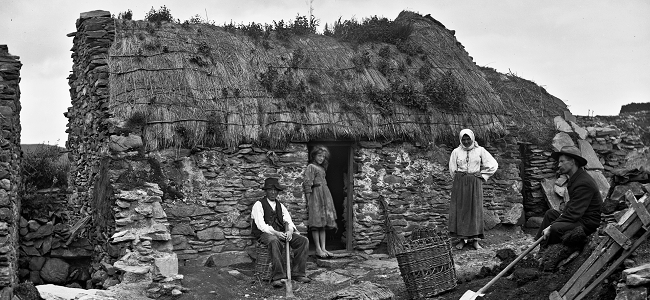
Tenant farmers, working from small farms in the diocese of Killaloe, mainly produced vegetables and corn, larger farms grazed cattle. Previously leases could have been set for forty years. Farmers had made their own repairs and improvements, draining the land and rotating their crops. The landowners made sure their land fully occupied – so that the land did not lie to waste, and become overgrown. Now when a farm became vacant, the new lease ran according to periods of prosperity or want – in times of plenty they were short term. The result being that tenants were not taking a long-term view of their future: by planning ahead, keeping back some of their produce – to use as next years seed, have a planned rotation of crops, or devise ways to improve the drainage – by digging ditches and drains. In the mid, 1750s, the poor majority in Ireland lived in utmost poverty.
Their accommodation was squalid, and their diets made up of potato, turnips and a little wheat, and milk and on rare occasions beef. The population was increasing at an enormous rate… It was only the narrow coastal plain, which provided a market economy – where they managed to sell some of its produce.
The poorer folk, living further inland up in the hills, depended on a subsistence economy. High rents were increasingly becoming unpaid – which generated debts – the result of which meant evictions. The property owners forced the poor to pay an ever-increasing amount for rent; the interest rates on owed money continued to rise. The whole system discouraged improvements in property and proper farm management, particularly towards land drainage, fertilization, rotation of crops, animal husbandry using fallow land – as a cushion for poor harvests. It was a self-generating national disaster, which seemed to be unstoppable – and as it turned out, was!
About this time Daniel O’Cary, adopted the Protestant religion and, wishing to anglicise his name still further – in order to make a distinction between the families, asked for a meeting with the then head of the family, to declare an oath whereby he would reassume the spelling of Keary – removing the prefix O and the use of C. Many of the Irish began to look beyond their local areas for employment. The more adventurous found that America and the Caribbean offered them more. America became an important land for Irish immigrant labour. The life appealed too many – for its religious nonconformity and political independence. The American war of Independence started in 1775 and was an inspiration to many of the Irish poor to get back at the English.
Chapter 6. The family meeting
James Keary married Mary in about 1760. In the late 1770s, there was a widespread agricultural crisis. This was not the first time that this problem, with the national food crop, had occurred – poor harvests, low cattle prices, high cost of wheat, potatoes and milk. All this, experienced before. The massive problem for Ireland was that the population relied upon a staple crop of potatoes – where the English relied upon bread as the staple diet the Irish relied upon potatoes. Corn was relatively simple to import and had a better shelf life. Potatoes needed careful handling from a suitable source and weight for weight was wasteful – it was also a difficult commodity to ship.
The enclosure movement caused further resentment, rents increased yet again and there was a decline in wages – inflation was rife. A number of militant movements raised popular passions – to influence the landowners and government – to reduce rents… all to no avail. Taxation, tithes, rents and church dues were a continual grievance. Commercial cotton spinning and weaving introduced into Ireland in 1777. Three years later modern machines and expertise – brought over from England, established an enterprise, which gave employment to many unemployed folk in towns and villages… This was the start to the great Irish linen industry.
O’Halloran, an Irish historian, writing in 1778 gave O’Meara as a Lord Chief of an ancient house, descended from the O’Brien clan. Many of the O’Ciardha clan joined in his service – with the Irish Brigade. A number of the clan then started to use the anglicised form of O’Carey, or O’Cary more often at the turn of the eighteenth century. Margaret Keary’s second son Thomas Padrick married Julia, daughter of Roderick Murphy of Castledermot in Kildare, who had four sons the eldest being named Thomas – as was the custom. He was the first of this family to stop using the prefix ‘O’ and to begin using the name of Keary. He married Mary, daughter of John Keogh of Castlepollard – an agricultural town in Westmeath, in 1815; John died in Dublin in 1836, interred in the churchyard of Artane.
The latest steam engines imported from England to provide power for many of the mills… no longer did the manufacturers have to rely upon water to drive their wheels. These engines required coal and allied services that in themselves created new business ventures…, which prospered, initiating further capital expenditure. Heavy industries like mining, iron and steel producers, pottery manufactures, tanning, glass ware and coach building all needed raw materials… delivered by road, canal, river and ports… These large building projects needed capital investment. Investors saw the opportunity to make a profit – they could see the outcome of an abundance of cheap labour and the profitability created by those first cotton mills.
This was the time rural populations in village and town showed a remarkable turn inwards – towards uniting – engaging in shared interests. These rural folk were in the main Catholics and spoke Gaelic, keenly aware that the city workers were ‘a set apart’ from their life in the village. Sporting events, fairs, markets, wakes, funerals, cockfights, hunting and field events abounded. These gatherings united people and stimulated political thought. Gradually the unrest grew until eventually nightly political meetings arranged. In Tipperary, Neath and Limerick under the pretext of hurling and playing football, crowds gathered, bands played, shouts were heard and fights broke out…these events confirmed Catholic strength and highlighted resident disaffection. Protestants feared the worst barricaded their houses on fair days and remained indoors. United Irishmen and Orangemen took to using these outings to start airing grievances, which always led to fights.
Thomas, son of Christopher Carey, and brother of William, Mathew and James…owned a newspaper in Dublin. He was sympathetic to the cause of united free Ireland printing stories about absentee property owners and the terrible conditions rural folk were living in. These articles produced attacks from The Establishment who accused him of printing seditious stories. Thomas, tried at the Kings Bench, acquitted. The ruling body continued to hound him and force his printing business to close down. The whole family were involved in the printing trade as either reporters or tradesmen. Mathew Carey 1785-1824, internationally known as a publisher. Born in Dublin 1760 indentured, to serve his apprenticeship as a letterpress printer, having to make up the sticks of type to be clamped into the forme. Later, befriended by Benjamin Franklin, immigrated to America where he married Miss Flavahan, devoting all his energies to the publication of the Douay Version of the Bible, founding the first American Sunday School Society and becoming one of America’s greatest publishers.
Dublin, by the turn of the century was the second biggest city in the British Isles. The most industrious and wealthy areas of Ireland were those closest to the English mainland; and in the middle of that coastline was Dublin, the seat of power – the legal centre and administrative capital. Its population contained the greatest number of professionals, guildsmen, artisans, journeymen and apprentices. This power gives a reason why Dublin was the centre of such unrest and revolution. The final straw was the drought of 1781. To provide freight and individual transportation a marvellous engineering scheme put into place – the construction of a great canal and series of locks to join Dublin to the River Shannon. This feat opened up the interior and controlled water distribution to the central plains eliminating the fear of future droughts. Ireland was now an independent country but sharing a common monarch… in reality, many ties were there to check true self-government, which was never workable.
In 1790, the Act of Union saw London replace Dublin as the centre of political power for the Irish. Thomas Kearey was born in 1791. That same year United Irishmen formed and Dublin barrister Theobald Wolfe Tone 1763-1798 published ‘Argument on Behalf of the Catholics of Ireland – which bought about the emancipation for Ireland’s Catholics. The Story of Ireland by Neil Hegarty.
By 1797, The United Irishmen were a powerful force in Leinster and plans made to have a general uprising. Oaths taken and promises made to ensure a committed gathering, which included trades people, shopkeepers, and many of the middle class. The Orange Order objected and mass atrocities perpetuated. Kilkeary Parish, was reported, by Ireland’s Ordnance Survey, as lying to the north of Co Tipperary between Nenagh, Cloghjordan, and Templemore… bounded to the east by Clonlisk in Kings. St. Ciardha’s Church (Cill Cheire – Church of Keary) lay near the centre of the Barony of Upper Ormond, situated one and a half miles southeast of Toomevara. Kilkeary was one of the fourteen parishes in the barony.
In 1818, although there were a number of the family who used the Keary spelling this was the first time that ‘ey’ was used in Ireland, it is to Patrick and Mary [nee Lonergan] we find recording this fact. Unfortunately, it did not last long; they removed the ‘e’ five years later. With the passing of a few more years Carey [with or without the ‘e’], Carew and Keary, seem to be an almost interchangeable choice by family members recorded in the Powerstown RC register. By the 1850s, Griffith’s Primary Valuation gives 68 Kear[e]y households in all of Ireland… Powerstown lies in the civil parish of Kilgrant in the barony of Iffa and Offa East, between Clonmel, and the village of Kilsheelan. It is difficult, from this distance, to comprehend the importance the spelling makes to the use of one’s name. However, records prove that it does… prompted no doubt by strong reasons at the time. Even today, some family members feel free to use the Gaelic form whilst others use the anglicized version.
The amount of farmland in Ireland was now unable to feed the expanding population. This fact occurred in almost all regions not just in the rich more industrial sectors with the greatest labour force. The problems stemmed from the way land controlled, by rents and tithes. Tenure was restricted so that farmers budgeted and planned for short-term gain. This did not bode well for economic rotation of crops; the construction of land drainage ditches; the removal of stone from the fields or the latest views on animal husbandry; the use of better soil management to increase fertility was much talked about. The landowners, property owners, and the absentee property agents employed agents to collect the rents transferred to England… making its way to English boroughs and the aristocracy. It was a case of negligence, ignorance, and lack of care – on the part of local and national governments, in both England and Ireland. The potatoes blight finished off what the poor economy had started.
Many Irishmen and women in the middle of the nineteenth century people lived close to where they were born – and never left their village. Records disprove that view. Even without those facts, reality dictates that that would be impossible. This was the age of large families. A large percentage of young people not long out of school would have to travel far to find, and be trained, for work. Local recourses could not sustain such large numbers and houses were in short supply.
By 1851, the year of The Great Exhibition, over fifty per-cent of the population was living more than a couple of miles from their birthplace. The advent of the bicycle made travelling to work easier and the coming of the railways added to the distance travelled. It was the growth of towns and cities, which drew the migrant workforce. It was not just the need to earn money or to find housing, it was also exciting for the young, and the job options more varied.
The O’Ciardha family had lost much in the confiscations over the generations, keeping the less productive high lands as insurance – somewhere they could retreat to when times were hard. Irish politicians blamed the depressed state of the economy on England’s restrictions of Irish Trade. The poverty of the rural economy they blamed on those who maintained the pasturage instead of promoting the growing of seed crops and potatoes. Gladstone’s Liberal Party with Irish support 1886 brought Home Rule bill before the Commons. Parnell died of heart failure at Brighton on 6tth October 1891.
‘O’Hart’s Irish Pedigrees of 1887, pp499, gives the ‘Keary’ family as (MacCeachraigh) of Galway as distinct from Carey. (Mac, Mc and M means the same as O – son of) Keating’s history gives the family as being numerous in Mayo and Sligo and recites: ‘there are other anglicized forms of the Gaelic name: the extinct Mac Fhiachra or Mac Fhearadhaigh, formally both of Tyrone and Galway, the synonym of Kerin (O’Ceirin or O’Ciarain) in Mayo and Cork. The English form of Mac Giolla Céire (Giolla means boy) further corrupted in Carr – (O’Carra and Mac Giolla Chathair) in Galway and Donegal’ and Mac Chathair in Co. Donegal. O’ Ciardha, Keary and Carey are more likely to be found in Munster particularly: Kerry (Ciarrai) and Clare (AN CLĀR.
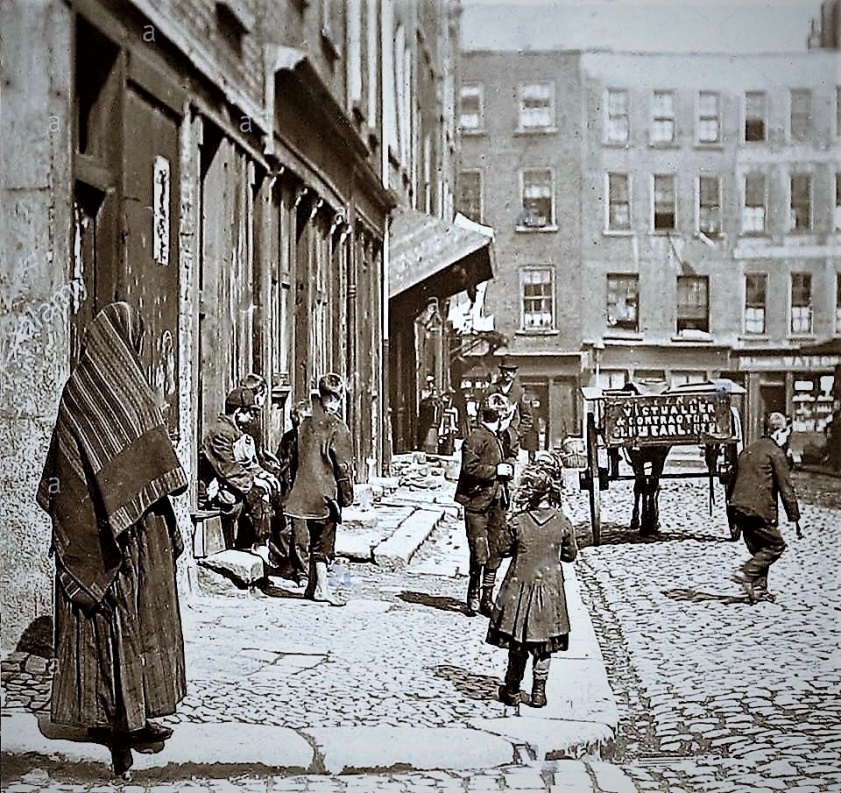
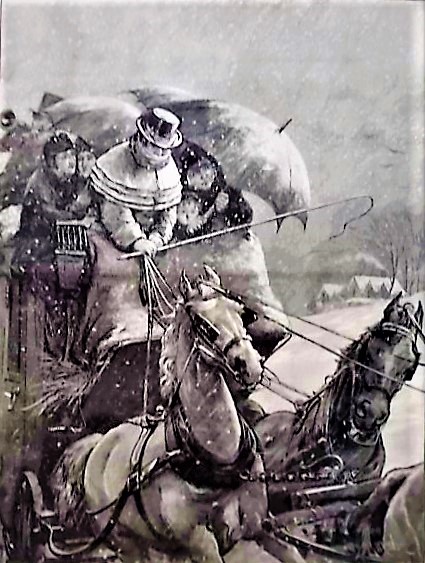
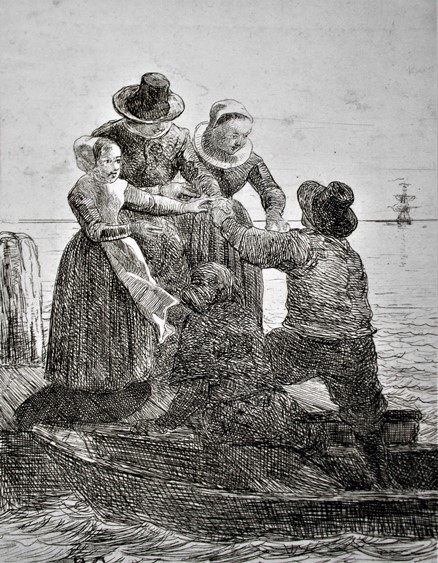
It would seem that it was mainly immigrants to America, England and its Empire, at the turn of the eighteenth century, who used Kear[e]y… this more Anglicized form. Those worldwide who use the Carey form are however, more numerous. Dublin was a setting off point for the immigrants, mostly to land at Liverpool. From there, a regular coach service to London, and other chief cities, took the migrant to where there was work. If London bound then it was to Westminster, and, as likely as not, ‘The Rookeries’ (Little Ireland) where cheap lodging to be found – perhaps with relatives.
My, great, great grandfather, Thomas Kearey 1791-1860 arrived at the Liverpool dockside in 1816, with his bag of tools over his shoulder – ready to start a new life… He was born in Dublin city (COI) Ireland, Archdiocese of Dublin, Baptisms, Nov. 1791, to Dec. 1791, baptised in St. Paul’s, Parish Church, Dublin, later that same year, to parents, James and Mary Keary, recorded DU-CI-BA-172933, Filename d-273-1-4-112. His 1841 and 1851 census forms, and 20th March 1860 death certificate, registers Thomas as a baggage worker, and gold and silver, smelter and refiner. Three years later, in 17th October 1819, Thomas married Ester Pepler of Great Stanmore by Banns (Married by Banns is a legal requirement, it’s an announcement of a couples intention to marry in church made on at least three Sundays in the three months preceding the wedding) in Saint Anne’s Church, Soho, Westminster, the service conducted by the Curate Edward Bowman.
This was the age of The Great Reform Act of 1830, modernising the parliamentary system of England. Seven years later Queen Victoria came to the throne. A further seven years later, Ireland suffered The Great Hunger, a famine that starved to death a million people.
Thomas and Ester were eventually to live in 20, North Row, Bromley. However, where did Thomas live, those years prior to meeting Ester – after his marriage, and before having children, is a mystery to be solved. It is now upto Timeline Genealogy Ireland to research starting by delving into Charles James Jackson’s English Goldsmiths London 1921, 2nd Ed. Checking the Roll of Dublin Goldsmiths, with dates of admission and parentage (NLI GO665).
When he marched down the gangplank, excited by the challenges that lay ahead, he sought passage to London by coach; relying on his skills as a worker in metal to find work – perhaps start a business… for Dublin’s silversmiths and goldsmiths were recognised as highly skilled artisans. These skills, working with precious metals, carried over to working with tin and lead – metals more closely allied to the home – servicing water-tanks, pipes, buckets, cauldrons washing and cooking pots and all other metal containers. Not only was he skilful shaping metal but also had knowledge of joinery and the manufacture of carts.
Thomas married Ester Pepler (born Collins) in 1819, her father Edward Pepler, born 1767 in Great Stanmore, Middlesex, died in 1843. Thomas and Ester started a family one year later, in 1820, giving birth to a son named Thomas. His siblings William, Mary, Hester, Charlotte, Elizabeth and Emma made up the rest of the family.
My great, great grandfather Thomas 1821-1867 – St. Giles, Middlesex described himself as a whitesmith, which today maybe better described as a tinsmith… and as a smelter – an extractor of metal from an ore. The O’Ciardha clan originally occupied the hills and lowlands on the east side of Lough Derg. The ore washed down from those hills would have been a combination of any number of metals. It would not be surprising to find local people adept at smelting that ore and either coating hammered out sheets of metal with tin, or combining tin and copper to make bronze or smelting lead and tin to make pewter. The smelter of one ore would be knowledgeable enough to work with any number of base or precious metals. Tin wares, were produced in London in the early 1600s, producers became incorporated by 1670.
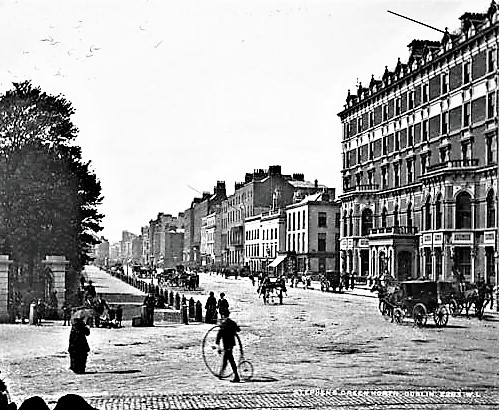
The skills of a whitesmith were more concerned with cutting, shaping and hammering-out sheet metal, making joints and seams… using a mixture of lead and tin to make solder – to give a watertight joint. He may have worked in silver making jewellery. However, when working in London it was highly unlikely that Thomas would have been working with this expensive metal. He would have been devoting all his energies working with lead and tin in a household environment, making and repairing pipes and cooking pans, pots and utensils for a working population. He married Hannah Raybould in 1841 who was born in 1822, in Fulham, her father a whitesmith. Thomas and Hannah had nine children, the first son was also given the name of Thomas.
My great grandfather Thomas Henry Kearey 1842-1900 was a highly trained blacksmith mainly engaged in manufacturing carriage wheel-rims married Mary Ann Chuter. His brother Alfred, my grandfather, 1854-1917,’ a house painter’ and decorator’ married Martha Sutton in 1878’ having eleven children – first son named Thomas Henry 1861-1882, his brother Albert, 1889-1971, my father, Albert Edward Kearey.