When Christ was born the Celts had no written language, developing their written word in the eighth century. Today there are three main dialects of Irish: Ulster, Connacht and Munster, affecting standard spoken pronunciation.
There are twenty six letters in the English alphabet sixteen in the Irish, adding j, k, q, v, w and x, z in some loan words. The basic vowels a, e, i, o, u are represented but their sound lengths are different.
Prior to the written word individuals had but one name chosen from their appearance, family habit, birth-date, or local surroundings. Their surname only became a necessity to pay the rent, tithe, or become recognised as a member of a larger community – a clan.
Tracing a family name that has changed from Primitive Irish, in the 5th to 10th century to Middle Irish in the 12th whilst Ireland being subjected to take-overs, and invasions, by: Vikings 800, Normans 1169-1300, Anglo-Irish, 1300-1400, Henry VIII King of Ireland 1541 and the ending of Gaelic lordships in 1603. Finally the English Parliament. The following century the tithe payment, to the established church, came on top of a rise in the birth-rate which pushed up rents; permission for Catholics to take out a mortgage on land, also had its effects. In the midst of it all – to bless us, Mary and James Keary of Dublin had a son in 1791 which named Thomas. It was this family which gave the English side of the family a start, continuing today. It is acknowledged that surnames in Ireland were used as early as the 900s. However, the number of people understanding such events were few and far between only those at the top table conversed using surnames. The Irish alphabet, reading and writing, were first exercised in Hedge Schools 1641 and Bardic Schools in 1750, National Schools began teaching in 1831 for Primary Education and 1892 for compulsory education for all. Irish was introduced into Ireland by iron-age Celts in the 6th century.
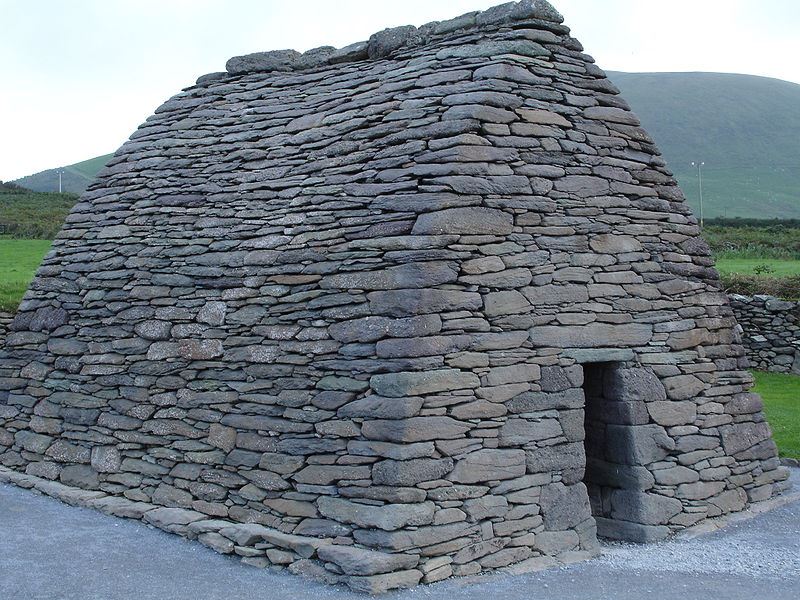
The family name of Ciardha is medieval Irish and according to history and literature they settled in south-western Ireland after making their way north then up south-western Ireland’s coastline, to Kerry, over time, spreading out throughout north Munster creating family groups to live in a number of caisels (enclosures of stone). Kerry or Keary (Irish: Ciarrai, or in the original language, Ciarraighe) means ‘people of Ciar’ which was the name of a Gaelic tribe and leader who lived within the county. Son of Fergus Mae Róich, king (‘toisech’) of Ulster, Ciar was leader of the ‘tuath’ (caisel or enclosure). Concobur Hua Muiredaigh, ri Ciarraige, king of Kerry 1033. Cendfaeladh lethri Ciarraighe king of Kerry killed by Muredach. (Kerry’s other king in 1055). Kerry had a number of kings of clans, showing how complicated seeking the facts can be. (Any use of the letter K rather than an Irish C (for a noun) is an adaption, used to conform to language, race, or ancient order).
So, we have our group of people – a collection of families – maybe related, a tribe, described as dark skinned – ‘Ciar’ in Gaelic, with a leader – chief, king. They have a home which they have built in a circle – a caisel of stone. They were of the land, a farming people. This tribe, people from southern Europe, had made their way across Western France and Eastern Spain to south western Ireland, today’s Counties Cork and Kerry (Ivernia), to the most western part, in 4350 BCE. Today known as the Dingle, Ivrea and Beira, peninsulas. Kerry is in the south-western Region of Munster bordered by County Limerick to the north-east and County Cork in the south and south-east. The whole area has many archaeological sites with an abundance of ancient monuments, all used and worshiped by the early people who populated Kerry.
Kerry is the kingdom of Ciar who was the son of Fergus mac Róich king of Ulster. County Kerry, in the province of Munster, was established in 1300, although has an earlier history, building its county town Tralee. Kerry known for its mountain ranges, possessing Ireland’s highest, its second and third highest mountain, its highest lake and oldest recorded sacred settlements. These natural elements known about in the 1st century AD have been referred to as ‘The Kingdom’ when the O’Connor chieftain ’Ciar’ ruled the territory between the Shannon estuary and the Maine River in the south. In previous ages known as Ciar na Cliath or ‘The Plain of Swords’ later Ciar Raigh (Céire) which translates as ‘Ciar’s Kingdom’ or ‘Ciar’s people’ later Anglicized. At that time engaged in prehistoric life styles and living arrangements. Kerry (Contae Chiarral) existed at about the same-time. The definition of Ciar is of a dark colour maybe brown or grey but heraldically it is black. That phonetically it serves today as the name Cera or Kear leads us to the name of Ceary or Keary.
The Barony of Caibhre in County Kildare, North Leinster, north of Kerry, where kings and dynasties of Mide and Brega existed under the Southern Uí Néill [not to be confused with O’Neill] were among the leading dynasties in the “middle kingdom” of Midhe from the 5th century up to the arrival of the Normans in the 12th century. Their main territories included the ancient areas about Mide and the plain of Brega, which included the modern counties of Meath and Westmeath, as well as portions of counties Longford, Offaly, Louth, Dublin and Kildare. Prior to the arrival of the sons of Niall of the Nine Hostages in the 5th century, the areas of Mide and Brega were ruled under dynasties which included the Laigin, as the area has been speculated to be previously a part of the kingdom of ancient Leinster. Of the sons and grandsons of Niall of the Nine Hostages who conquered territory in this area, there included Lóegaire, ancestor of Cenel Lóigaire; Conall Cremthann, ancestor of Clan Cholmáin (Mide) and Sil Áeda Sláine (Brega); Cairbre, ancestor of Cenel Cairpri Laigen and Cairpri Gabra; Fiachu, ancestor of Cinel Fiachach and dynast of Fir Cell; and Maine, dynast of Tethba.
The first Irish surname is recorded as being O’Clery or O’ Cleirigh which is about as near as one can get to O’Ciardha, about 920 AD. By the end of the eleventh century the main families who recorded, interest in their family tree, had acquired many of the surnames we know today all of which were started by Niall Mac Aoidh who died in 917 AD.
It is recorded that in The Kingdom of Midhe {Meath) of the five Irish provinces Meath was the smallest comprising the present day counties of Meath and Westmeath. After the Norman invasion it became part of Leinster. Kilkeary Parish lies close to Nenagh further west in north Tipperary. Midhe included the ancient capital – Tara. The main tribe and family of this area by the 1000s were the Mac Laughlin of the Cann Cholmain tribe, another leading family were the Chiardha clan along with others.
When reading Irish history it becomes apparent that tribes, clans, families, septs etc., moved about, because they were forced to by others, who were jealous, grabbing more land and stealing cattle. It is a human trait that drives people to take back, or, get their own back – teach a lesson too. This becomes a habit which is passed on.
A great deal is made of the Keary Clan occupying Carbury (Carbery) (Rosscarbery) near Drumbeg Stone Circle, West Cork of the Barony of Caibhre, County Kerry The Middle Kingdom, in this context refers to the ancient Irish territories referred to as Mide and Brega, which very roughly equated to the areas about modern counties of Meath and Westmeath. The plain, north of the river Liffey, has been referred to anciently as Brega, or Breagh, which held one of the great ritual and royal sites in ancient Ireland, that of Tara. Early sources suggest that a king who held the title Temro” (king of Tara) was often held in greater respect above the other kings and lords on the island. It has been said that Ollam Fodla first gave historic fame to Tara by founding the Feis (or Triennial Parliament) there, seven or eight centuries before Christ. Prior to the arrival of the sons of Niall of the Nine Hostages in the 5th and 6th centuries, this area of Ireland was probably inhabited by the tribes of the Ui Failge, Ui Enechglaiss and Dal Messin Corb.
The Kearey (Ciardha or Chiardha) Ancient history
The Annals of Tigernach, written by Tigernach Hua Braein, abbot of Clonmacnoise, d1088. The first fragment found of his writings were dated 374-419. Their social-history appeared slowly originating from the Christian-Roman world. Constantine accepted Christianity 313 AD and by 391 AD it was illegal to worship other Gods. In the fourth century the Book of Kells was started
J. P. Mallory gives: “Ireland (Scotia), also known as Hibernia, is an island next to Britannia, narrower in its expanse of land but more fertile in its site. It extends from southwest to north. It’s near parts stretch towards Iberia (Hiberia) and the Cantabrian Ocean (i.e. the Bay of Biscay), whence it is called Hibernia but eventually called Scotia, because it has been colonised by the Scoti.”
The book ‘The Ancient and Present State of the County and City of Cork by Charles Smith, M.D. tells us that in 125 AD a memorable battle was fought at Ard – Neimheidh, i.e., the ‘Great Island,’ between Niadh Nuaget and Aengus, monarch of Ireland who recovered the crown of Munster from the latter. Keating, p.227.
The oldest names for the island and its people date from the seventh century, the name of Ireland is Scandinavian and today’s official name is Eire, the alphabet omits some English letters, , one being the letter K. The first time the name Ciardha (Keary) is mentioned in The Annals of Tigernach, which was also the Annals of Ireland, is 992 B.C., page 348, gives: Mael-Ruanaig, grandson of Ciarda, king of Cairbre, as being killed by the men of Teffa (Loughrea). Cairbre – (Coirpre Irish, Carbury English) Ciardha king of Tara, given as a 3rd century king and baron of Carbury.
The title and subject of this work concerns the Kearey ‘clan,’ a Gaelic word which means ‘family’- sharing a common surname originated in Ireland in the 17th century about the time of Cromwell. In ancient times the origins of a clan were based on one chief. Clan can also mean a tribe, meaning family, stock, and offspring, taken from Latin planta.
It is recorded that the original clan Ciardha later disappeared from written history. In reality, being scattered and unled after many battles. It is however likely that clan members in troubled times, holding onto family traditions, were sensibly keeping a low profile living in less populated parts, of south western Ireland out of harm’s way. What is strange is that those that bear the Gaelic name and history have not over the centuries published its history leaving future family members without the truth.
When much of Ireland was taken over by the Anglo-Normans clan members change the spelling of their surname from Gaelic Ciardha to Irish/English Ceary, or English, Keary. That did not change the pronunciation of the name but helped family members become integrated, achieve neighbourliness, perhaps a home, a job, and the ability to feed the children. Thankfully the original name survives.
Universal surnames did not come into use until the 12th century, at a time when the English language established itself,” according to Mallory.
Fortunately Medieval Ireland by Michael Richter is a valuable source of information regarding dynasties which eclipsed the previous tribal kingship groups of the clan, (derbfine, tarfine, indfine) – fixing the community. Previously the clan, or sub-clan lived within a mound-surrounded settlement. The society acted and performed in the most basic fashion of life, their homes, lifestyle and community structure, no different than any other groups of peoples throughout the world. It is the influx of other people’s advanced behaviour which generates change.
After Christianity had been recognised and adopted the settlement included a church. There were neither towns nor village in ancient Ireland, watermills were introduced into Ireland in seventh century. Family surnames names became more common from the eleventh century, this determined the political and cultural landscape of Ireland leading into the Middle-Ages.
In the third century, Adare, a village situated on the banks of the river Maigue, nine miles from Limerick and about the same from Cork, runs into the estuary of the Shannon. This part of Ireland was inhabited by the Hy-Fiáhgeinte who were a large and powerful tribe, sub-divided into several septs. The district was the home of the Hy-Cairbre, one of those clans led by their king happily living in the fertile valley of the Maigue. This was one of the clan Ciardha. There were other lesser clans.
In 855 the Norwegians invaders made their first appearance in Limerick to the north and later to Cathal where one of the chiefs married the daughter of Amlaf now king of the Norwegians of Munster. Donovan, the son from this marriage, lived at Bruree, close to Adare. He was killed by Brian Boroimhe who later was driven out of the country after the battle of Clontarf in 1014. The Hy-Cairbre, after the death of Donovan, gradually lost their importance, final disposed by the Anglo-Normans in 1572. The clan were driven into Kerry, where the name O’Ciardha (Keary) survives, some say in history only. Taking up one of the ‘cantreds’ on which the rural deaneries were founded. These cantreds were the early feudal partitions of the English lords and each had their own castle: Limerick, Kilmallock, Adare, Ballingarry, Ardagh, and Rathkeale.
The course of Irish history changed again as the ruling classes asserted themselves forcing out the original population by a system of tithes, rents and taxes. This continued by design, greed and ignorance throughout the following centuries; the monied classes and landed gentry disregarded the working peasantry, who too had a right to life and expectation. Strife and sorrow became the result, caused by ignorance and selfishness. A lack of farsightedness reigned which gave nobody any permanent satisfaction.
In 1166 Mac Murrough ousted by Rory O’Connor, who was now the high-king, sought support from Henry 11 which ultimately led to Ireland becoming divided into Anglo-Norman and Irish areas. It took over fifty years to establish a near English administration. Towards the end of the twelth century into the thirteenth it appeared that the Irish and English would be able to get along. The period shows ancient Irish society had not given up its cultural identity but remained quite different. This difference has never changed, the clan has always been more important.
The behaviour of the ruling classes has always been transitory – unable to devise a social system that is fair to all and lasting. It seems that some individuals have to assert themselves and in the case of Ireland in the Dark-Ages killing, theft, slavery, and rape persisted the object being to brag, frighten, amass power, and steal land.
As previously explained the surnames Keary, Kearey, and its variant, Ceary, are the Anglicisation’s of the ancient Irish family name Ó Ciardha or O’Ciardha. A onetime kingship, acknowledged clan, known in Leinster, with a Gaelic name still in use today. This is not to pass-over, devalue or dismiss other derivations of the name for there are many of equal or higher standing. Past generations of the greater family have not only changed the spelling of their name but their country; all to escape servitude, bondage and suppression, caused by stronger clans, bad general-ship, the influx of settlers and just plain theft. Whilst writing I have stumbled over the: O’Conor, O’Kelly, O’Kerry (Irish Ciarrai or Ciarraighe) O’Kenny, and O’Cleirigh families, and others, connected with the people of Ciar an ancestor of O’Conor the people called Ciarraighe who ruled five territories taking the name Kerry (Carey) the leading family descended from Heremon. Cork got its name from Ciar a short time before the birth of Christ referring to a large territory in Munster called ‘Ciar’s kingdom’. O’Conor king of Kerry descended from Ciar their great ancestor Conciar or Conior. The Carews (Carey) were marquises of Cork. O’Ciardha or O’Carey, chiefs of Cairbre O’Ciardha, now the barony of ‘Carbery’ in the County of Kildare. The clan O’Carey were also in Mayo and Sligo, Hy-Maine and the principality of the O’Kelly’s.
Irish Pedigrees by John O’Hart
Keary, pages: 202, 232, 282, 314.
Carey, pages: 202, 232, 282, 341.
The aim of my studies has been to find out my family’s history and it’s not getting any easier. The object, to discover what part of Ireland I can most likely call home, and how past members of the family lived, played, and died. Along the way, perhaps, discover what part the family played in Irish history which was and is very strong, whilst seeking out Heraldic Practices.
To help me I have personally sought Grant of Arms 08. 03. 2021, as the method, to make my quest official and complete, thankfully the application granted – including emblazon and registration; naturally a sum being necessary when lodging all such far reaching applications. This has been done by including a great deal of research finally engaging Timeline Research Institute of Dublin.
Acceptance by Ireland’s Livery rested upon whether Thomas Kearey 1791-1860 was Irish and first sons through the ages: Thomas Kearey 1820-1867 born London; Thomas Kearey born London 1842-1900; Thomas Kearey born London 1881-1882, were part of the greater family, able to be firmly linked by certificate and census.
The Office of the Chief Herald, held by Ms. Colette O’Flaherty, is housed in the National Library of Ireland’s, Department of Manuscripts and Special Collections. This office ensures that pronouncements are given proper standing and recognition. The total sum payable divided, the first part allows proof of Irish connection to be made and for design work to begin – to represent the family in the whole process, overseen by Herald, Mr. Donal Burke, the second part – the balance, paid before Letters Patent written and the final arms painted – by the Herald Painter – this final payment made July 2022.
Researching my DNA was an important first step: the deoxyribonucleic is an acid and polymer composed of two polynucleotide chains, the coil forming a double helix. The polymer carries genetic instructions for the: development, functioning, growth, and reproduction of our organisms including many viruses, carrying one of the four major types of macromolecules essential for life.
The object was to find the race of people who first settled in Ireland. They would be communicating, using their language of Celtic/Gaelic. The presence of Early Mesolithic sites at Lough Boora in Co. Offaly and also along the Blackwater in Co. Cork indicates that Ireland could have been colonized not just from the north-east but also from the south. The Origins of the Irish by J. P. Mallory p49. The language probably during the Neolithic Indo-European of c. 3000 BC originated among the earliest farming communities in southwestern Europe. P299.
My maternal DNA H5a and paternal Haplogroup H-P96 showed my ancestors to be one of the earliest Stone Age People – later, early farmers in the Neolithic period in Western Eurasia, in this case Ireland, to make the first sortie into Ireland, introducing a good start to my quest. It would seem to be clear that there were at least three migration streams the latest being Ukraine constituting 80% of the Irish population with R1b male DNA.
By the turn of the 10th century AD the Gaelic speaking Irish, Scots, Manx, West Country and other lesser island’s formed a common northern Celtic speaking group – a Y-chromosomal Haplogroup R – M269, Haplogroup which shares a common ancestor with a single nucleotide polymorplasm mutation.
In the future the hunt for connection, seeking the construction of a family tree, will be based on the science of genetic discoveries. Individuals may seek those connections to build their family’s history. The Mesolithic People came later followed by the Bronze Age introducing the Celts in 500 BC. Later one such group inhabited Kildare, believed descended from Chathair Mór, son of Feidlimid Fiorurghlas, High King of Ireland who reigned for three years – later killed by Conn Cetchathach. The introduction of Christianity to Ireland eventually brought about fewer minor wars, limited: slavery, theft, homelessness and rape, cementing family and clan bonding. To ensure a definitive recorded date I have given Christianity introduced into Ireland, in the Fourth year of the reign of Laoghaire, King of all Ireland.
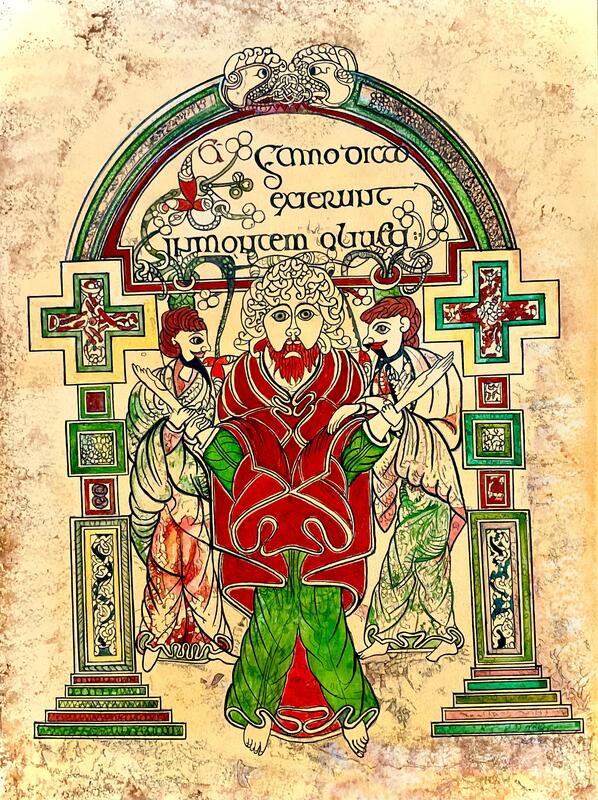
To give a further link to the past and to Ciardha’s presence I have chosen the writings of The Book of Kells which was linked to the Isle of Iona and Kells in Co. Meath. Whilst pillage and rampage was going on between clans Christianity was never far away. The book was written on calfskin vellum tensioned on a frame. The gospel associated since the middle Ages to Colum Cille, abbot of Iona born in Donegal into the ruling family of Ui Neill in 521, a great-great-grandson of Niall of the Nine Hostages, the founder of the dynasty. The Annals of Tigernach written earlier gives many references to the fact of Ciardha being known during Adomnan’s time whilst compiling a book on the subject of Holy Places and events of the time.
Tomas Cardinal Fiaich, in ‘The Beginnings of Christianity’, chapter 4, page 41, gives, ‘Irish Christians sufficiently numerous by 432 to justify the appointment of a bishop by Rome.’ Ciarán mac Ainmirech of Clonmacnoise one of Ireland’s monastic founders in the sixth century belonged to the Cenél Connaill, from which abbot Colum Cille originated.
It is recorded that the origins of the family name ‘Ciardha’ are believed to be the wish of the Irish Saint ‘Ciar’ in about 620 AD, when Fiachra son of Ciaran died, its Gaelic origin as black or sable, perhaps derived from black hair or dark complexion rather than the Scottish Pict’s description of a people who painted themselves. The written name Ciardha was used by scribes in 650 A.D. Chéire, St. Ciar was the foundress of Cell Chéire (Kilkeary). Ciar’s father was named Dub Rea, (there are a number of translations) leader of Cairpre, an ancient warrior clan living near Granard. Erainn a tribal group which includes the Múscraige Tire in the Barony of Ormond Thire (on the shores of Lough Derg) and Arada Tire – Barony of Owney and Arra, County Tipperary. The Ciarraige Luachrs gave their name to County Kerry. Conghalach Ha Ciardha lord of Cairbre.
The family becoming part of the Cenél nÉogain ruled by Muirchertach mac Muirelaig son of Éochaid mac Domnaill, king of Cenél nEogain a large group of families descended from Eoghan, brother of St. Columba, elder son of Niall Noigiallach of the Nine Hostages, (nine clans owing allegiance to the fifth-century monarch who founded The Northern Ui Néill dynasty).
The Irish had five Gaelic kingdoms in the fifth to eleventh centuries: Ulster, Leinster, Munster, Connaught and Meath each with a High King. In that time Cairpre Gabra was not a powerful tuath but were ‘descendants of Coirpre’ the eldest son of Niall occupying land in the middle of Ireland which bordered with Meath ruled by the Southern Ui Neill centred on Granard, today’s Longford, an area at that time bearing the first Christian centres in Ireland.
By the twelth century they were beaten by Conmhaicne tribes and absorbed into the larger Annaly kingdom given shelter by O’Farrell’s fortress, the O’Ciardha (Keary), descendants of Niall becoming established as lords of Carbury about the same time as the Anglo-Norman invasion of Ireland. Margaret Dobbs ‘The Territory and People of Tethba’ 1941 7th Series, Vol 11, No.3.
The following shows clearly that king Ciardha of Carbury was a tribal chief of a group of clans or families which included Cerry, Celly, Cenny, Ceary, Ciarie, Ciarrai, Cary, and others, all related to Coirpre, eldest son of Niall, based around Carbury, before and during the first century, well before the castle built.
During this period in history: Aethelred II ‘The Unready’ King of the English 978-1013 reigned. Edmond Ironside King of the English 1016. Henry 1 King of France 1031-1060. 1031 The Ommiad Caliphate of Spain dissolved. In 1034 Malcolm of the Scots dies. Canute King of England 1016-1035. King Harold Harefoot dies 1040, a period which includes, according to ‘The Annals’, king O’Ciardha.
The Annals of Tigernach
(Also, Annals of Ireland, 807 B.C. to A.D. 1178).
by
The Abbot of Clonmacnoise
The work was transcribed in 1870-1885 and named Revue Celtique by Professeur H. D’Arbois de Jubainville au College de France, printed in Paris 1895, edited by Whitley Stokes 1830-1909. Consists of a number of written works. I give three instances, to give proof and method.
1. Page 290. MaelRuanaid Ua Ciardha, ri Cairpri, do marbad do Gallaib Atha cliath isin bliadain sin .i. do mac Turnin 7 do mac Aedha Hui Ferghail 7 Cellach Ua Findallan ri Delbna moire leo beous tria mebail .
(See T 1165-10) (<< In this year MaelRuanaid Ua Ciadha, king of Cairbre, was treacherously killed by the Foreigners of Dublin, namely, by the son of Turnin and by the son of Aed Hua Fergail, and also Cellach Hua Findallan, king of Delbna MOR >>).
2. Page 295. (Flann mac Donncadhs Ua MaelSechlainn do marbad O’ Chairpri (I.e.) (<<Fland, son of Donnchad Hua MaelSechlainn, was killed by Cairbre Hua Ciarda >>
3. Page 414. The men of Teffa, and the Muinter Geradain, and the Cairbri Hui Ciada went on a raid into Offaly, and reached the glebe of Cell eich (leg. Cell Achaid?), where a defeat was inflicted upon them, and Hua Ciarda and the son of Mac Findbairr, chief of the Muinter Geradain, and a great multitude, were slain.
(See T 1176-16) (Flann son of Donnchadh O’Maelseachnaill was killed by Cairbre O’Ciardha.
The previous has been taken from ‘The Annals of Tigernach,’ written in 993 AD. Translated by Gearoid Mac Niocaill, Electronic edition compiled by Emer Purcell, Donnechadh O’ Corrain. Publication CELT Corpuss of Electronic Texts, University of Cork, Ireland. There were three parts covering mostly 489-1178 AD surviving from the 14th century MS Rawlinson B488. The point here being that they mention O’Ciardha (Keary), king of Cairpre. Carbery lies at the very southwestern point of Ireland, not so very far from the city of Cork – the second largest city in Ireland. Districts of McCarthy of More, of Muskerry, and of Reagh surround the city hemming in Carbery to its coastline.
For ‘T’ read, The Annals of Tigernach. And the page number.
T 993-2. Mael Ruanaig-ua Ciardha, ri Cairpri do marbadh la Firu Teftha.
T 993–2. Maelruanaidha O’Ciardha, king of Cairbre, was killed by the men of Teffa.
T 1000.5 Aodh O’Ciardha was blinded by his brother namely Ualgarg, grandson Ciardha.
T 1020-9. Cu Luachra Conchobhair, king of Ciarraighe Luachra, died.
T 10024-10. Maelruanidh O’Ciardha, king of Carbery, died.
T 1029 -2 A great loss of life on Lnis Lainne in Cairbre Mor
were forty persons of nobles of Cairbre were burned alive including Aodh O’ Ruaire king of Cairbre and the superior of Drunclifff.
T 1046-5. Fearghai O’ Ciardha, king of Cairbre was killed by the men of Teffa.
T 1067-5. O’Conchobhair of Kerry, king of Carraighe.
Luachra killed in Connacht.
T 1138.2. Mathghamhain O’ Conchobhair, king of Ciarrsighe and of Corca Dhuibhna, tanist of the king of Munster, rested.
T 1138-5. Dealbhna Mor, wherein was slain Domhnall O’ Ciardha, king of Carbury.
T 1145-9. The defeat of Dun Dubain by Murchadh O’ Maclseachlainn and by Cairbre O’Ciardha on the men of Breifna, where 300 men fell, including Searrach O’ Connachtaigh and Cathal O’Cathluain and O’Cumrain.
T 1150-1. The Giolla Claor O’Ciardha, king of Cairpre, fell by the Ui Faelain.
T 1155-5.The Giolla Got O’Ciardha, king of Cairpre, was killed by Donnchadh O’Maelseachlainn.
T 1165-10. A great war between the Meathmen and the men of Brefne, and Sitriue was killed by the Ui Ciardha and by Cairbre.
T1174-10 Mael Ruanaidh O’Ciardha king of Cairpre, was killed by the Foreigners of Dublin in that year, i.e. by the son of Turnir and by the son of Aodh O’Fearghail and also Ceallach O’Fiondallar, king of Delbna Mor.
T 1176-4 Two score of the English were killed by the son of Giolla Padraig O’Ciardha.
T 1176-13. Domnall Mac Giolla Padraig, king of Cairbre O’ Ciardha was treacherously killed by O’Maclseachlainn.
T 1176-16 Flann son of Donnchadh O’Maelseachnaill was killed by Cairbre O’Ciardha.
Unfortunately The Annals of Tigernach in 993 AD has not been quoted in Wikipedia to mention The Giolla Got O’Ciardha, king of Cairpre, was killed by Donnchadh O’Maelseachlainn. Later, Donnchadh’s son was killed by Cairbre O’Ciardha, maintaining history between, 993 – 1176.
If you can give light and colour to the previous snippets of early Irish history you will get a good idea what the bulk of the males were doing. Why were they engaged thus what was it they wanted and what were the females doing. Is this behaviour any different today, has the human race changed, improved and developed?
The old Irish root ‘ciar’ or céir is ‘dark’, perhaps black or sable. Tigernach mac Cairpri (d549) an early Irish patron saint of Clones (Co Monaghan) in the Province of Ulster.
In 1090, the Annals (gospels) reported the Book of Kells returned from Donegal, in the kingdom of Midhe ancient territories of Mide ‘the midland part’, and Brega ruled by king Finnechta Fledach. The king (or ‘toisech’ Irish for tribal chief) ruled over a people(Irish túath) responsible for the well-being of the tuath. The law tract Crith Gablach (early eight century) says ‘ri’ (cognate with Latin rex a regendo dicitur) because he rules (ridgedly). Ireland had over a hundred kingdoms which means that the tuath was relatively small.
This was a territory in the north of the present county of Longford, comprising the mountainous district now called Sliabh Chairbre, otherwise the Carn Mountains. Lanigan in his Ecclesiastical History of Ireland, vol. ii. p. 100, is puzzled to distinguish the territories of Carbury in Meath from each other; and Duald Mac Firbis falls into an error in placing Cairbre Ua g-Ciardha in Conmhaicne Maighe Rein, i.e. Mac Rannall’s country, in the county of Leitrim. See his Genealogical work (Marquis of Drogheda’s copy, p. 217). But the exact situation of Cairbre-Gabhra and Cairbre-O’g-Ciardha can be easily determined from the topographical poems of O’Dugan and O’Heerin, in which O’Ciardha is placed in Leinster, south of the Eiscir Riada, and O’Ronan, Chief of Cairbre Gabhra, in the ancient Meath. See Genealogies, Tribes, and Customs of Hy-Fiachrach, p. 276, note g, and p. 475. The fact is that Cairbre-O’g-Ciardha is the present barony of Carbury in the county of Kildare, and Cairbre-Gabhra is the present barony of Granard in the county of Longford, where the sons of Cairbre, the son of Niall, were seated in St. Patrick’s time, to whom they granted a beautiful place called Granard. See O’Flaherty’s Ogygia, part iii. c. 85. The following entry in the Annals of Connaught, at the year 1420, will show that the castle of Granard was in the territory of Cairbre Gabhra: ‘Caislen Granaird i Cairpre Gabrai do gabháil for h-Uilliam Hua Fergail do Gallaib. Gaill do tréccadh an caisléin iar sein, & Uilliam dá brisead ar oman Gall.’ ‘The castle of Granard, in Cairpre Gabrai, was taken from William O’Farrell by the English. The English afterwards abandoned the castle, and William demolished it from fear of the English.’ The mountainous parts of this barony still retain the name Cairbre, and the vivid traditions in the country respecting the curse pronounced by St. Patrick on the territory, where he was treated with indignity by the incredulous Cairbre, the monarch’s brother, show clearly that the district about Granard was originally called Cairbre. This is further corroborated by the account of the Attacottic tribes in Ireland in the second century, preserved in the Book of Lecan, and transcribed by Duald Mac Firbis into his genealogical work, in which it is stated that a tribe called Tuath-Glasraighe had been seated in Cairbre and in the adjoining districts around Lough Sheelin, until they were dispossessed by Tuathal Teachtmhar. It has already been stated that the mountainous portion of the barony of Granard still retain the name of the territory, and that the highest elevations of the district are called the Carn mountains; and it may be worthwhile to add here that, according to the Dinnsenchus, the carns from which this name has been derived were called Carn-Fubuidhe and Carn-Maine, which are described as on the summits of Sliabh Chairbre. After the O’Farrells had extended their power over the whole of North Teffia, they divided the territory of Cairbre-Gabhra into two parts, of which the northern or mountainous portion was called Sliabh Chairbre, and the southern or more level portion Clann-Seeain or race of Shane, or John, from the sept of the O’Farrells who possessed it. For a list of the townlands comprised in the district of Sliabh Chairbre, or, as anglicised, Slewcarberie, see Inquisition taken at Ardagh on the 4th day of April, in the tenth year of the reign of James I. From The Irish Charters in the Book of Corpus of Kells.
The tuath was divided into: nobility, freemen, scholars, lesser freeman, and serfs. Neither towns nor villages existed before the ninth century, people lived together in a caisel, an enclosure of stone. Medieval Ireland by Michael Richter.
Clan Ui Chiardha Barony of Caibhre in County Kildare, North Leinster is the present barony of Carbury.Co. Kildare.. Kings and Dynasties of Mide and Brega.The Southern Uí Néill [not to be confused with O’Neill] were among the leading dynasties in the “middle kingdom” of Midhe from the 5th century up to the arrival of the Normans in the 12th century. Their main territories included the ancient areas about Mide and the plain of Brega, which included the modern counties of Meath and Westmeath, as well as portions of counties Longford, Offaly, Louth, Dublin and Kildare. Prior to the arrival of the sons of Niall of the Nine Hostages in the 5th century, the areas of Mide and Brega were ruled under dynasties which included the Laigin, as the area has been speculated to be previously a part of the kingdom of ancient Leinster. Of the sons and grandsons of Niall of the Nine Hostages who conquered territory in this area, there included Lóegaire, ancestor of Cenel Lóigaire; Conall Cremthann, ancestor of Clan Cholmáin (Mide) and Sil Áeda Sláine (Brega); Cairbre, ancestor of Cenel Cairpri Laigen and Cairpri Gabra; Fiachu, ancestor of Cinel Fiachach and dynast of Fir Cell; and Maine, the dynast of Tethba.Onomasticon Goedelicum describes the boundary of Brega as: “its bounds seem Belach dúin (alias Castlekieran in the barony of Kells Upper) and the sea; the Boyne and Cassán (at Annagassan, southeast of Castlebellingham).”
It must be remembered that the settlement social structure, those inside, were extremely primitive, crude and uncouth looking for spiritual salvation in a whole variety of made-up acts and beliefs. The only quality the people looked upto was brutality, crudity and coarseness that offered some sort of security to weaker souls.
In descent from Cairbre (MOR) meaning first or senior son of Niall of the Nine Hostages a branch of Cenel Cairpre included Ua Chiardha (O’Keary, O’Carey) of Ui Cairpri Laigen in Carbury, County Kildare. With a location of county, Barony or Townland ‘Crioch Cairpre Droma Cliad of northern county Sligo and north-east county Letrim in the Barony of Carbury in north Sligo. Cineal (kingship) uibh Neill a’ Tuaisceart. There is some indication the Ui Neill kingdom in the area of County Kildare did not exist before the 12th century, of Ua Cairpre being driven from north-east Longford and Offaly (i.e. Cairpre Gabra) due to pressure from Ua Ruaire of Breifne and the Conmairecne expansion in the region.
‘The annals cite for Cairpre Laigin (Ua Chiardha between 954-2 – 1176-16). Ualgarg Ua Ciardha king of Cairpre killed Cetnach son of Flann king of Luige.‘
There is no doubt that the O’Ciardha were a paramount family in early Ireland; a kingship which slowly became reduced by supporting the losing side, to be finally crushed by King Henry and later Cromwellian forces. Reading between the lines ‘The Annals’ give a sordid record of ancient Irish clan life – basically, killing each other, stealing each another’s cattle, taking revenge, all to advance ownership, popularity and power.
As John Grenham records: ‘The history of Ireland is a great drama of war, invasion, plantation, immigration, emigration, conflict, and solidarity.’ This rather sums up Ireland and the Kearey family. Still, this is not unusual.
My application for Grant of Arms, to the Chief Herald of Ireland has tested my Irishness, both ancient and modern, and my patience. During the research, I have gained greater knowledge of Ireland’s ancient history, sought out whom my ancestors might have been but not found out where Thomas came from before taking ship to England.
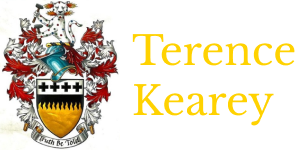
Heraldry is not restricted to just the Western World. Its introduction began with the need to recognise who was friend or foe, when tempers frayed – in the heat of battle. Shields and helmet crests carried and worn in the thirteenth century when the practice of embroidering armorial ensigns on the surcoat worn over a ‘coat of mail,’ introduced the term ‘coat of arms.’ Letters Patent grant the Ensigns and Arms to the family. The Norman pointed shield (Escutcheon) contains the figure, or design – painted in colour (Tincture) that form the ‘coat of arms’, in this instance the shield, divided (parting the shield’s field), horizontally (per fess) as radiant, seen as flames in yellow, covering the bottom half of the shield (Or). This suggests flames from a furnace melting ore or heating metal – a family skill. The flames background Black, (Truth) defines in Gaelic, the use with ‘Ciar,’ connecting the family’s Gaelic name. In heraldic terms, Black, written as Sable. These two colours, ‘Sable and Or,’ are ‘the family livery colours’. Above the flames, are four crosses remembering the four brothers killed in WW1 and their Christian upbringing, their top half position on the shield suggests the family were living north of the River Thames. On top of the shield a helmet with closed visor, appropriate for esquires – gentlemen-at-arms. On either side of the helmet mantling’s, scrollwork or flowering drapery, originally there to protect the helmet. Arranged, on top of the helmet, a slightly curved wreath, a chaplet of the two coloured livery silks wound round each other. Above the wreath the Crest, a demi-panther incensed rampant guardant, (flames emanating from besides its mouth and ears) facing the viewer. A panther also represents a beautiful woman and mother who is tender and loving to her children and will defend them, even with her own life. The animal displayed with roundels of red meaning (fortitude), blue (loyalty), green (hope) holding in each front paw a blacksmith’s hammer once again making a link to past family skills. These are all armorial bearings: crest, helmet, shield, and overall design, suggested by the Herald taking regard to the life of the person I claim Irish descent from and the following generations; the scroll is the Herald Painter’s design, and the motto, suggested by myself. Over time, the Ciarraige Tribe of the Eoganacht People moved south and west towards Co. Cork and Kerry having travelled through the ages from Co. Sligo and Letrim. This movement of people shows how transient life was when pressure applied by powerful neighbours caused fear and terror.
The Ciarraige Tribes or ‘black people’ populated much of north-western County Roscommon believed to be the lords of Airtech – present day barony of Frenchpark. Their seat Baslic near Castlerea. Early peoples of Desmond included the Ciarraige Luachra. Domnall was the son of Muirchertach mac Neill and grandson of Niall Glundub. A member of the Cenel nEogain northern Ui Neill.
Now you have been introduced to the past family O’Ciardha who ruled this area of today’s Carbury County Cork we should begin our story covering Ireland’s history of south-west Ireland.