The Sword and the Plough
Perhaps the start of it all.
by
Terence Kearey (Ciardha)
Taking an interest
Delving back into the past – looking for others with the same name, can open a Pandora’s Box – it’s a fairly common past-time and can lead to exciting finds. For my brother, his muscular dystrophy demanded a wheel chair and desk, these his basic tools which started his detective work. Having an enquiring, tidy mind, he began building a family tree. Over time, as the tree grew and blossomed, his letters revealed a Thomas Keary born 1791, in Ireland, to parents James and Mary Keary. Thomas was baptised in St. Paul’s Church, Dublin, a Church of Ireland, not a Catholic Church, on the 4th December 1791. Helping to fill in his Census Form in 1851 Thomas had added an (e) to his surname and was living in 20, North Row, Brompton, North London. His profession was given as a gold and silver melter (as written). He filled in a census form of 1851 by that time he was aged sixty, married to Ester Pepler of Great Stanmore, with three children, all living at home.
This was the time of The Great Exhibition and a time when building railways across the countryside was not only a massive task but drained labour from the land giving employment to thousands by opening up new industries and building new towns. This is all very interesting but not what I began my searches for, I wanted to know about how Thomas lived, whether he went to school, what was life at home like, something about his parents and grandparents, the place where he lived and the local community.
There are many peoples living abroad whose relations had done exactly the same, they too had started a family tree finding all the same problems, of language, lack of information, unreadable forms: be they church, state, local authority or house holder. Whereas they may have been keen to seek their relatives, those living in Ireland have no such urges – not understanding that names or spellings had to be changed purposely, for those individuals who took the plunge, to become assimilated in their chosen country and find a living. They may also have expected to understand either Irish or English, not understanding that there are, or were, three dialects of Gaelic making tracing places and individuals an added trial on top of impossible spellings of those places. Little did he know it would stir-up within him a longing for the past to find a family history by hook, or by crook? In my turn, I too picked up the baton, to do exactly the same – to find my Irish beginnings. After engaging investigators, Ireland’s Heralds, in their library home, reading numerous books, and a visit to Ireland, seeking to find Thomas’ family connections, but failed.
Now I look for how and where the Irish name evolved how it was used, formed, and spelt. To do this I have had to start at the very beginning when Ireland was formed, populated, developed and how closely related it was to its neighbour.
I have chosen The Ice Age – when it began, to sufficiently melt for wandering stone-age peoples to take it upon themselves to make their way ‘over yonder,’ to a land they could see – to its shoreline, to what is today called the County of Cork, and wider still, to Munster. A people who were related to numerous others across Europe all in similar groupings eventually to be given the common name of ‘Celtic peoples’. These stone-age people would have to make their way inland up through numerous coves and inlets around the southern coast choosing eventually to settle on top of the cliffs facing the sea to give protection. You may well ask what protection – to protect from whom. There were homosapiens and later hunter-gatherers the infiltrations of Celtic people began around the fifth century.
County Kerry’s Emblem and Coat of Arms
Right, so here we are then, no home as yet but there’s the sea, with plenty of fish, a rugged land, nobody about but plenty of potential. This band of people, looking for security, were starting to build a home. They were led by a man who was forceful, when he spoke he sounded knowledgeable and sure of himself, giving leadership seemed natural. His first advice was to build a mud and stone wall circulating around all the places where the body of people were sleeping, eating and rearing children, which was on the top of the cliffs. This then was to be their home not just for one but for all who were in the body, of family and friends, who had started out in the beginning, they were now all being guided by this man, who had been accepted as leader – their chosen one, the king. They felt secure. So it all began…
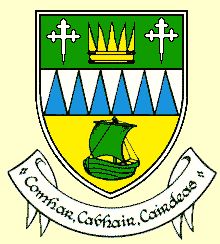
Four meanings drawn wihin the Emblem of Kerry.
The crown stands for the Cruithni linked to the Ciarraige tribe, the pre-Gaelic populatiion of Kerry.
The two crosses for monesteries Ardfert and Aghadoe.
The boat represents St. Brendan discovering America.
The motto means: co-operation, help, friendship.
Ciar, is a dark colour, black or brown, it is also a family name, referred to as ‘Ciar’s people,’ and a ‘given name’ to help build a Kearey clan.
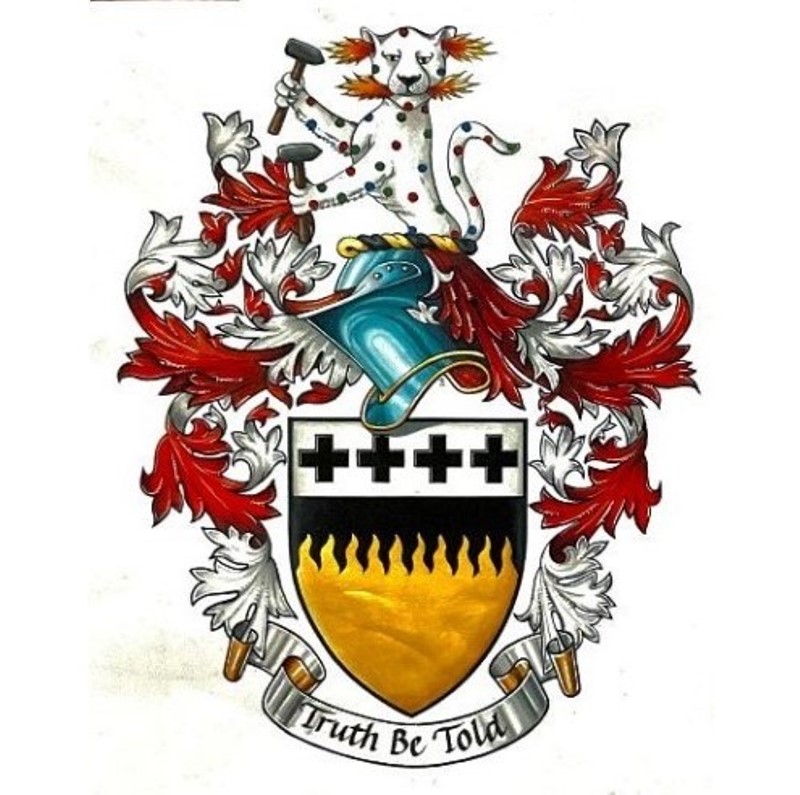
Kearey Coat of Arms
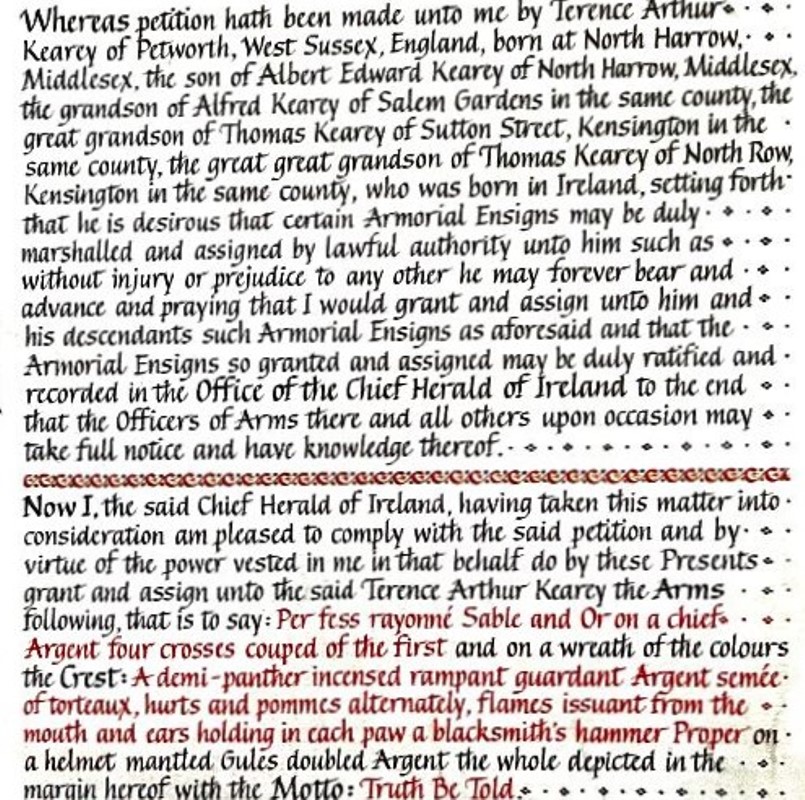
Letters Patent
CONTENTS
Words 32, 032.
25.03.24
Pictures
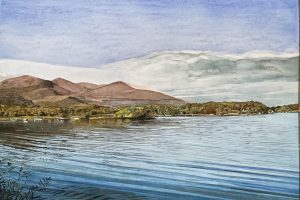
Cover: Lough Leane, Ross Castle,
Christ Arrested
Kerry Coat of Arms
Kearey Coat of Arms
Carbury Castle
St. Ciar
Fore Abbey
Kilkeary Church and inserted pic.
Kilkeary Parish Map c1640
Kerry and Cork Map
Ireland Map 1580
Kilkeary Cemetery
Abbey of Fore
Eviction
Dublin, penny farthing.
Dublin street scene
Ireland’s Heraldic Arms
Map of Kerry and Cork
Contents
Introduction.
Chapter. 1. Kearey.
Chapter. 2. St. Ciar.
Chapter. 3. The Vikings.
Chapter. 4. Kilkeary.
Chapter. 5. Thomas.
Chapter 6. Southern Ireland History and Acknowledgements